
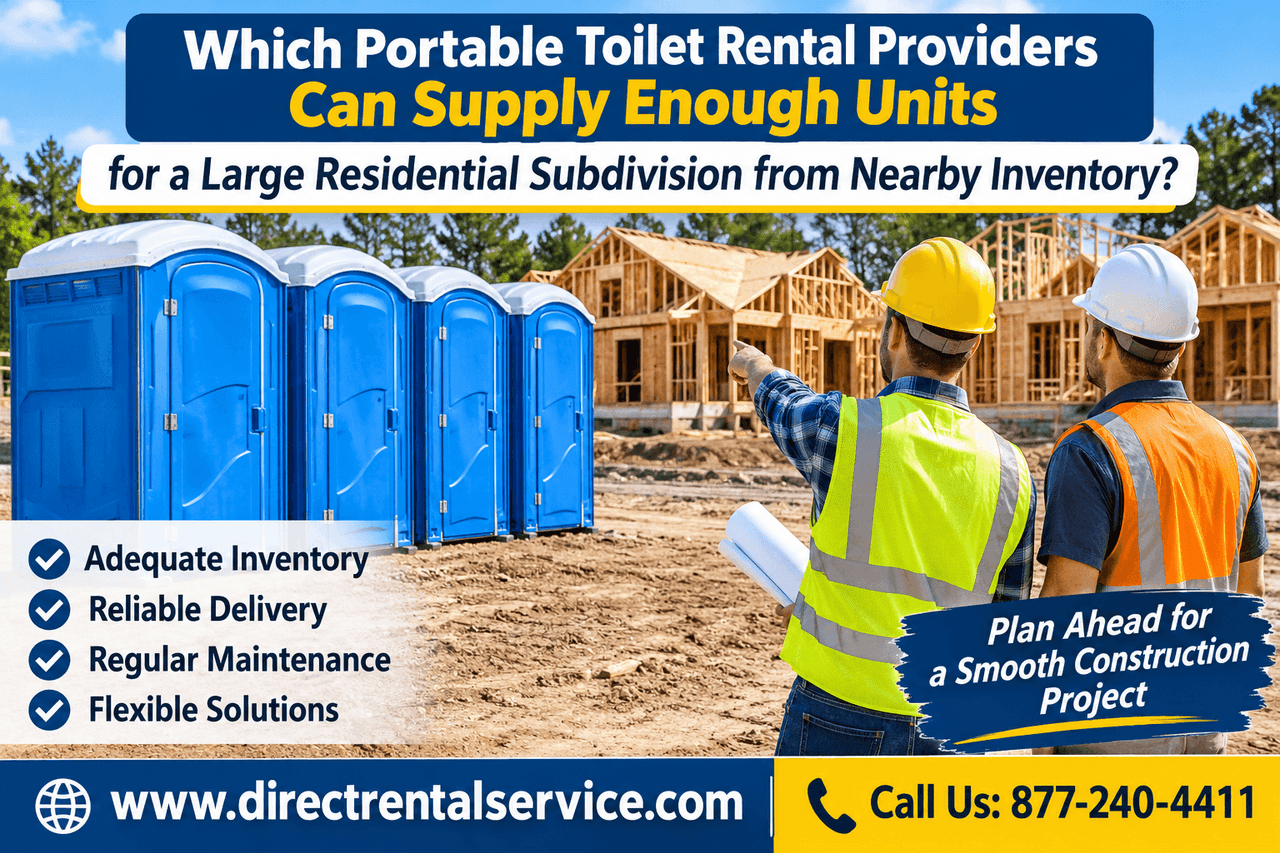
Which Portable Toilet Rental Providers Can Supply Enough Units for a Large Residential Subdivision from Nearby Inventory?
Developing a large residential subdivision requires careful planning, coordination, and access to essential facilities. From land preparation and road construction to home building, landscaping, and final inspections, multiple construction activities take place simultaneously. Workers, subcontractors, supervisors, inspectors, and delivery personnel may all need access to restroom facilities throughout the project.
One important challenge for construction managers is determining which portable toilet rental providers can supply enough units for a large residential subdivision using nearby inventory. When several construction crews are working across different sections of a development, having an adequate number of portable restrooms available is essential for maintaining sanitation, supporting worker productivity, and preventing unnecessary interruptions.
Selecting a provider is not simply about finding a company with a large inventory. Project managers must also consider local equipment availability, delivery capacity, servicing schedules, transportation distance, and the ability to accommodate changing construction requirements.
1. Why Large Residential Subdivisions Require Multiple Portable Toilets
A residential subdivision can cover a substantial area and contain dozens or hundreds of homes under construction. Unlike smaller residential projects, these developments often involve multiple contractors working in separate sections.
For example, one crew may be installing underground utilities while another is preparing building foundations. Additional teams may be working on framing, roofing, electrical systems, plumbing, and road improvements.
If restroom facilities are limited to one location, workers may spend additional time traveling between their work areas and the available facilities.
Providing enough portable toilets throughout the development helps address several operational challenges:
Reduces unnecessary walking distances for construction workers.
Supports better workplace sanitation and hygiene.
Helps accommodate multiple crews working simultaneously.
Reduces congestion around restroom facilities.
Provides convenient access for supervisors, inspectors, and subcontractors.
Supports compliance with applicable workplace sanitation requirements.
The number and placement of units should reflect the actual workforce, site layout, project duration, and applicable regulations.
2. Which Portable Toilet Providers Should Construction Managers Evaluate?
The most suitable providers are generally those with established local or regional equipment inventory, reliable transportation resources, and experience supporting large construction projects.
Rather than selecting a provider based only on its advertised service area, construction managers should investigate the following provider categories.
A. Local Portable Toilet Rental Companies
Local providers can be a practical starting point because their equipment may already be located near the subdivision.
Their proximity can offer several advantages, including shorter transportation distances, easier coordination, and potentially faster responses when additional units are needed.
However, local availability should never be assumed. A smaller provider may have sufficient inventory for a few construction sites but may not have enough units to support a large residential development.
Before making a decision, ask how many units are physically available, how many are already committed to other customers, and how many can be delivered within the required timeframe.
B. Regional Portable Sanitation Providers
Regional providers may operate multiple equipment yards across neighboring cities or counties. This arrangement can be useful when a subdivision requires a substantial number of portable toilets.
Their inventory may be distributed across several locations, allowing them to coordinate equipment from nearby branches.
Construction managers should confirm whether units can be transferred between locations without delaying delivery. They should also determine whether the provider has enough drivers, service vehicles, and maintenance personnel to support the entire development.
C. Large Multi-Location Rental Providers
Larger portable sanitation companies may have broader operational networks and established procedures for managing high-volume construction accounts.
Their resources may include multiple equipment depots, dedicated service teams, transportation fleets, and centralized scheduling.
Nevertheless, a large provider does not automatically have available equipment near every construction location. Its regional inventory may already be allocated to other projects.
The important consideration is whether the provider can demonstrate actual nearby availability rather than simply confirming that it serves the area.
3. How to Determine Whether Nearby Inventory Is Sufficient
One of the most important steps is calculating the subdivision's total restroom requirements before contacting rental providers.
The calculation should begin with the maximum expected workforce rather than the number of homes being constructed.
For example, consider a residential development with 150 workers distributed across several construction sections. The project manager should evaluate applicable OSHA requirements, the number of workers present during each shift, and whether facilities are accessible to all crews.
Under OSHA construction sanitation requirements, the number of toilets required depends on the number of employees. For projects with 20 or more employees, the general requirement is one toilet seat and one urinal per 40 workers up to 200 employees, with additional requirements for larger workforces. Specific conditions and exceptions may apply.
This regulatory calculation provides a starting point, but the project may need additional units because of its geographic size, shift schedules, and worksite layout.
Questions to ask providers include:
How many standard portable toilets are currently available nearby?
Can the required quantity be delivered in one shipment?
Are additional units available if the workforce increases?
Can units be distributed across multiple construction sections?
What is the procedure for emergency replacements?
How frequently can servicing be scheduled?
Obtaining clear answers helps prevent equipment shortages after construction begins.
4. Why Delivery Capacity Matters as Much as Inventory
Having enough portable toilets in a warehouse does not necessarily mean a provider can deliver them on schedule.
Large subdivisions may require units to be installed at multiple locations, including separate building phases, temporary worker gathering areas, and road construction zones.
Delivery capacity depends on several operational factors:
Transportation availability: The provider needs enough suitable vehicles to move the required equipment.
Installation scheduling: Delivery teams must coordinate access with construction supervisors and site managers.
Site accessibility: Unfinished roads, muddy ground, excavation areas, and temporary traffic restrictions may affect placement.
Delivery coordination: Units should arrive according to the construction schedule rather than being delivered before suitable placement locations are ready.
A provider should review the subdivision map and proposed delivery locations before confirming a large order.
5. Planning Portable Toilet Placement Across the Development
The physical layout of a residential subdivision can create challenges that are not present on smaller construction sites.
Placing all portable toilets near the main entrance may be convenient for delivery vehicles, but it may not serve workers building homes at the opposite end of the property.
A better approach is to divide the development into operational sections.
For example:
Section A: Foundation preparation and underground utility installation.
Section B: Framing, roofing, and exterior construction.
Section C: Plumbing, electrical, and interior finishing.
Section D: Roadwork, landscaping, and common-area development.
Each section should be evaluated according to workforce size, distance, accessibility, and construction activity.
Portable toilets should be positioned on stable, accessible ground where service vehicles can reach them without interfering with construction operations.
Project managers should also consider privacy, pedestrian safety, accessibility requirements, and separation from food preparation or material storage areas.
6. Establishing a Reliable Cleaning and Maintenance Schedule
The availability of portable toilets is only one part of successful sanitation planning. Regular servicing is equally important.
A large residential subdivision can generate significant daily usage, especially when several contractors operate simultaneously.
The servicing schedule should consider the number of workers, unit capacity, project activity, weather conditions, and expected usage patterns.
Routine servicing generally includes waste removal, cleaning, restocking supplies, and checking the overall condition of each unit.
Construction managers should establish a reporting process for issues such as:
Full waste tanks.
Insufficient toilet paper or hand sanitizer.
Damaged doors or locks.
Unpleasant odors.
Leaking or unstable units.
Units requiring relocation.
A designated site supervisor can help monitor restroom conditions and communicate maintenance requirements to the provider.
7. Comparing Providers Before Making a Decision
When evaluating several portable toilet rental providers, construction managers should compare more than rental prices.
A useful evaluation should include:
Evaluation factor
What to verify
Nearby inventory
Actual available units in local depots
Delivery capacity
Ability to transport the required quantity
Service coverage
Availability across the entire subdivision
Maintenance
Cleaning frequency and waste removal
Flexibility
Ability to add or relocate units
Emergency support
Replacement and repair response procedures
Project experience
Experience with large construction developments
Written confirmation of inventory, delivery dates, servicing arrangements, and additional-unit availability can help reduce misunderstandings.
8. Managing Changing Requirements During Construction
Residential subdivision projects rarely follow an identical schedule from beginning to completion.
Some sections may finish ahead of schedule, while others may experience delays due to weather, material shortages, inspections, or changes in construction activity.
As a result, restroom requirements can increase or decrease throughout the development.
Project managers should review the portable toilet arrangement whenever workforce numbers or construction phases change.
If a new section begins construction, additional units may be necessary. If another section becomes inactive, existing units may be relocated to areas with greater demand.
Maintaining communication with the rental provider allows equipment quantities and servicing arrangements to be adjusted as project conditions evolve.
Finding portable toilet rental providers capable of supplying enough units for a large residential subdivision requires more than identifying companies that operate nearby. Construction managers must verify actual local inventory, transportation resources, delivery schedules, maintenance capacity, and the ability to support multiple construction sections.
Local providers, regional sanitation companies, and larger multi-location operators can all be potential options. The right choice depends on available equipment, workforce requirements, project geography, and service reliability.
By evaluating these factors before construction activity increases, developers can establish a practical restroom plan that supports worker sanitation, reduces operational interruptions, and accommodates the changing needs of a large residential subdivision.